
Uttarakhand Director-General of Police Ashok Kumar informed that 168 people are still missing following the glacier burst.

In a letter to the chief secretary, government of Uttarakhand, Union Power Secretary Alok Kumar said the land subsidence in Joshimath was a very old issue, dating back to 1976, and the construction of the 4x130 megawatt Tapovan Vishnugad project started only in 2006 by NTPC.

It stands at a distance watching soundlessly as multiple teams work to reach those buried under mounds of debris and is sometimes heard breaking into howls of anguish -- a canine sentinel watching the rescue mission in its search for its missing puppies.

A portion of the Nanda Devi glacier broke off in Uttarakhand's Chamoli district on Sunday, triggering an avalanche and a deluge in the Alaknanda river system that washed away hydroelectric stations, leaving at least seven people dead and 125 missing who are feared dead.

Groups of relatives have gathered at the Tapovan tunnel, hoping that their loved ones will emerge alive from its mouth.

The focal point of the multi-agency rescue operation for the last over four days remains the more-than-1.5-km-long "head-race tunnel" of the total 2.5 km of the tubular structure, as every passing minute is mounting concerns over the safety of those trapped inside.

Three more bodies were recovered Monday from the Tapovan tunnel, taking the toll in the Uttarakhand flash flood to 54 as hopes of finding survivors there over a week after the disaster dimmed.

Security personnel at work inside the tunnel rushed out and heavy machines engaged in drilling through the debris and sludge inside were withdrawn.
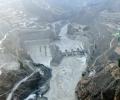
At the devastated Tapovan power project site rescuers worked nonstop even as the odds of finding the trapped workers alive seemed slim.

Making a statement in the House "regarding an avalanche in Chamoli District of Uttarakhand", the Union minister said these inputs were based on the information received till Monday 5 pm from the state government.
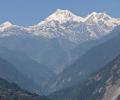
Melting of Himalayan glaciers has doubled since the start of the 21st century due to rising temperatures, losing over a vertical foot and half of ice each year and potentially threatening water supply for hundreds of millions of people in countries, including India, according to a study published in 2019.
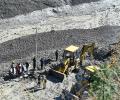
'We have been appealing to various governments for so many years that there should be no dams in the Himalayas, but no one listens.' 'Nature responded in its own way.'

Using drones and remote-sensing equipment, rescue teams intensified efforts on Wednesday to reach the 25-35 men trapped in a sludge-choked tunnel since the Uttarakhand glacier disaster three days ago and more than 170 remained missing, hopes of finding them alive fading with every passing hour.

Uttarakhand Chief Minister Trivendra Singh Rawat said saving lives and extending all help to the families of the deceased is the state government's priority.

Locals hold gradual land subsidence responsible for the fissures and attribute it to the widening of the national highway, violation of norms in construction works related to mandi parishad, erosion caused by the Pindar river and unsystematic flushing out of rainwater.

Imposing a blanket ban on construction of houses and commercial establishments along the banks of rivers, Uttarakhand Chief Minister Vijay Bahuguna on Monday announced setting up of a statutory body to look into planning and development of the flood-hit areas of the state.
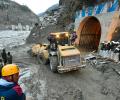
Besides, 28 human limbs have also been recovered from different places in the affected area out of which one has been identified. Thirty-three bodies out of the 62 recovered so far have also been identified, police said, adding the DNAs of unidentified bodies are being preserved.

'These kinds of tunnels are not meant for the Himalayas.' 'Development should be good for all people and not where you make a tunnel and 40 people get trapped.'

Suneel pandey, who lives on the banks of the River Ganga in Kankhal, near Haridwar, says that the disaster unfolding in Uttrakhand is shocking, but hardly surprising.
Suneel pandey, who lives on the banks of the River Ganga in Kankhal, near Haridwar, says that the disaster unfolding in Uttrakhand is shocking, but hardly surprising.
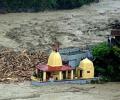
There are lessons to be learnt from the Uttarakhand tragedy. Topping the list is the need to immediately stop mindless construction activity in the Himalayan hills, says Nitish Priyadarshi

'The present government swears by Hinduism. But we lost three of our sants during earlier BJP regimes.'

A 13.2 MW small hydro project on the Rishiganga river was swept away in the glacier burst in Uttarakhand on Sunday, but there is no danger of floods in the downstream areas as the water level has been contained.

Tapovan Hydro-Electric Power Dam, also known as Rishi Ganga Project was completely washed off following a glacier burst in the Chamoli district, said the Indian Air Force's initial report as Advanced Light Helicopter (ALH) deployed at Joshimath has undertaken recce of affected areas.

'How much rain fell on June 16 and 17 is NOT known because the area of Kedarnath is not covered by the Indian Meteorological Department,' M Shashidhar Reddy, vice chairman of the National Disaster Management Authority tells Sheela Bhatt. Because of this, the NDMA will not know "what exactly happened over there, in and around the Kedarnath temple."

Two major hydel projects being built by construction majors GVK and L&T have suffered severe damages in the floods which hit Uttarakhand last week.
These beautiful photos of India will give you travel goals.
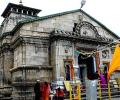
The pilgrimage to Kedarnath was suspended on Wednesday for three days in view of the weather department's warning of heavy rains in the area and frequent blockage of roads to the Himalayan shrine following intermittent showers in the valley over the past few days.

If the Ganga manages a rebirth, so will the country.Roy

The Supreme Court asked the Union environment ministry to review six specific hydroelectric projects on the upper Ganga basin in Uttarakhand.
'Geological processes occur at time scales that are beyond human imagination, but we need to understand these events.'

'For lakhs of people in the flood-afflicted state, battling against the elements is taking a huge toll. This is the time of the year that apples ripen, rice starts being harvested and preparations start in full swing to put aside some of the food stocks for the long winter months ahead. At this moment, though, people there believe if they can succeed in coming out of this calamity in one piece they will have won the war,' says Rashme Sehgal.

The Ganga agitation and the question of preserving the Himalayan ecology has become a deadly cocktail of politics and religion. Behind the scene, of course, at play are powerful business interests. What is needed is an independent scientific assessment of the problem and preparation of a blueprint for preservation of the Himalayan rivers and associated ecology, says Dinesh C Sharma.
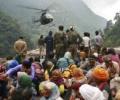
With weather clearing up, relief operations on Sunday gained momentum in Uttarakhand as the government came out with a roadmap for clearing tonnes of debris and extricating bodies in Kedarnath and adjoining areas ravaged by flash floods over a month ago.

The uproar over 'dams' following the Uttarakhand disaster is ill-informed & potentially counter-productive, says Anand Sankar
